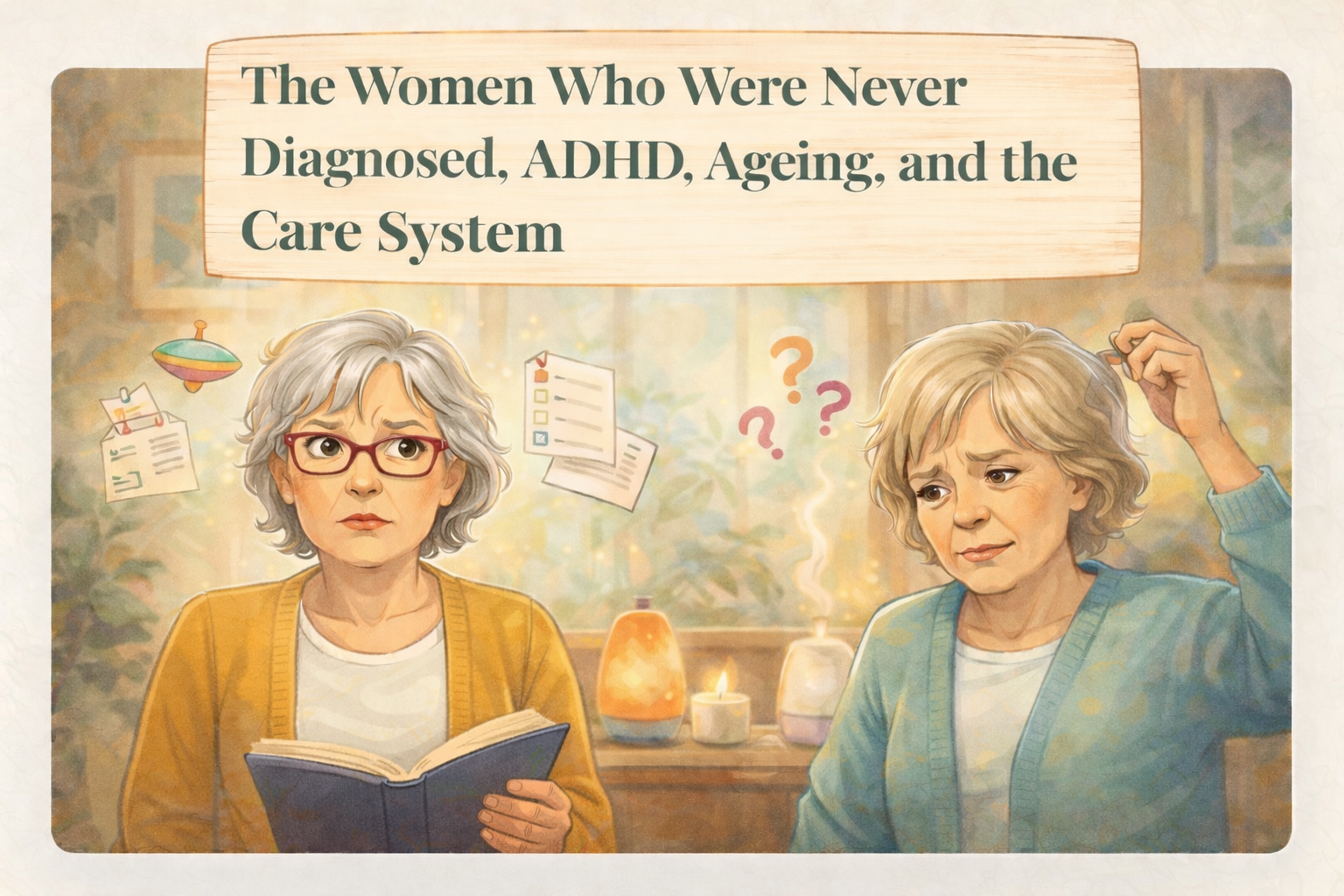
This International Women's Day, it feels right to talk about a group of women who have spent most of their lives being told they were too much, not enough, or simply difficult. Women who were anxious, disorganised, exhausted, and quietly falling apart behind a carefully maintained surface. Women who were diagnosed with depression, anxiety, or personality disorders, sometimes repeatedly, before anyone thought to ask whether they might have ADHD.
There is a generation of women, now in their fifties, sixties, seventies and beyond, who grew up at a time when ADHD was considered a condition that affected hyperactive young boys. Girls who could not sit still were told they were naughty. Girls who daydreamed were told they were lazy. Girls who talked too much were told they were disruptive. And girls who internalised all of it, who learned to mask and manage and compensate, were largely invisible to the diagnostic systems that might have helped them.
The consequences of that invisibility do not end at retirement. For women who enter care in later life still carrying an unrecognised ADHD profile, the risks are significant. Their behaviours may be misread. Their needs may go unmet. And the system designed to support them may not have the tools to understand them.
Why Women Were Missed
The research is unambiguous on this point. ADHD is significantly less likely to be diagnosed in females than in males, particularly in childhood, and females who do receive a diagnosis typically receive it later in life. A 2024 paper in The Lancet Psychiatry confirmed that females are diagnosed with ADHD at lower rates and at older ages than males, with a male-to-female diagnosis ratio of approximately 3.9 to 1 in childhood. The gap narrows in adulthood, but only because women are finally, often after decades of struggling, finding their way to diagnosis.
The reasons for this disparity are well documented. ADHD in women tends to present differently from the textbook picture. Where boys and men are more likely to show the hyperactive and impulsive symptoms that draw attention in classrooms and clinics, girls and women are more likely to have the inattentive presentation: forgetfulness, difficulty sustaining focus, poor time management, emotional dysregulation, and a chronic sense of underachievement relative to their evident intelligence.
These symptoms are easier to overlook. They are also easier to explain away. A girl who cannot organise herself is assumed to be immature. A woman who forgets appointments is assumed to be overwhelmed by life. A woman who interrupts conversations or speaks impulsively is assumed to be rude. The behaviours that in a boy might prompt a referral are, in a woman, absorbed into existing cultural narratives about femininity, emotionality, and incompetence.
Masking compounds all of this. From an early age, many girls with ADHD develop sophisticated strategies to hide their difficulties: watching others carefully to learn how to behave, overworking to compensate for disorganisation, using humour to deflect from mistakes, and performing competence even when internally overwhelmed. A 2023 systematic review published in the Journal of Attention Disorders found that women with ADHD frequently internalise the experience of functional impairment, resulting in feelings of shame and self-loathing rather than visible distress. Masking works, in the narrow sense that it conceals the condition. But it comes at an enormous cost.
A 2025 study published in Scientific Reports, drawing on the lived experiences of women with late-diagnosed ADHD, found that the years before diagnosis were characterised by persistent self-blame, exhaustion, and a sense of being fundamentally broken. Many had been treated for anxiety and depression for years without anyone identifying the underlying cause. The diagnosis, when it finally came, was often described as both a relief and a grief: relief at finally having an explanation, and grief for the decades lost without appropriate support.
The Menopause Complication
For women with ADHD, whether diagnosed or not, the hormonal changes of perimenopause and menopause introduce a further layer of complexity. Oestrogen plays a significant role in regulating dopamine, the neurotransmitter most closely associated with ADHD. As oestrogen levels decline, many women with ADHD find that symptoms they had previously managed, sometimes for decades, suddenly become unmanageable.
Research published in 2025 by King's College London, involving 656 women aged 45 to 60, found that as ADHD traits increased, so did menopausal difficulties across a range of domains including memory, concentration, anxiety, depression, and psychosocial functioning. Professor Ellie Dommett, the study's senior author, noted that "the presence of ADHD may impact how women perceive and attribute their experiences during the menopause," with implications for how women are supported during this period.
For women who have never been diagnosed with ADHD, this hormonal transition can be particularly disorienting. Symptoms that had been masked or managed for years may suddenly surface or intensify. Memory difficulties, emotional dysregulation, difficulty concentrating, and a sense of cognitive fog may appear to emerge from nowhere. In the absence of an ADHD diagnosis, these experiences may be attributed entirely to menopause, or to early cognitive decline.
This is where the risk of misattribution begins. And it does not stop at menopause.
When ADHD Looks Like Dementia
The overlap between ADHD symptoms and the early presentation of dementia is well established in the clinical literature. Both conditions can involve difficulties with attention, memory, organisation, and executive function. Both can present with emotional dysregulation, impulsivity, and social disinhibition. The differences are real but subtle, and they require careful assessment to distinguish.
For older women with undiagnosed ADHD, this overlap creates a significant risk of misdiagnosis. A 2020 article from Harvard Medical School noted that older adults with ADHD frequently struggle with attention, memory, and planning in ways that are almost indistinguishable from mild cognitive impairment. Research published in Frontiers in Aging Neuroscience has explored whether ADHD in older adults represents a genuine risk factor for dementia, or whether it is being misdiagnosed as mild cognitive impairment due to symptom overlap, concluding that the evidence supports both possibilities and that careful differential diagnosis is essential.
For a woman who has spent her life developing workarounds for her ADHD, the loss of those compensatory strategies in later life, whether through bereavement, illness, reduced social support, or the cognitive demands of ageing, can cause a sudden and dramatic deterioration in functioning. To a care professional who does not know her history, this deterioration may look like the onset of dementia. The ADHD that was never diagnosed becomes, in old age, the dementia that was never questioned.
What This Means in a Care Setting
When a woman with undiagnosed ADHD enters residential care, she brings with her a lifetime of adaptive strategies, sensory sensitivities, and behavioural patterns that the care environment may not be equipped to understand.
She may be restless and find it impossible to settle in communal spaces. She may be impulsive in conversation, interrupting, speaking without apparent filter, or becoming quickly frustrated. She may be hypersensitive to noise, texture, or smell in ways that make standard care environments actively distressing. She may have strong preferences about routine and become disproportionately distressed when those routines are disrupted. She may struggle with the passive, unstructured time that characterises many care home days.
In a care setting operating on a neurotypical model, each of these behaviours carries a risk of misinterpretation. Restlessness may be read as agitation and managed with sedation. Impulsivity in conversation may be read as disinhibition associated with frontal lobe dementia. Sensory distress may be read as anxiety or challenging behaviour. Distress at disrupted routine may be read as rigidity or confusion. The woman herself, who may have no language for her own neurodivergence, may be unable to explain what she needs.
This is not a hypothetical concern. It is the logical endpoint of a diagnostic gap that has been accumulating for decades. The women who were missed as girls are now ageing. Some are already in care. And the care system, like the diagnostic system before it, was not built with them in mind.
What Good Care Could Look Like
None of this is insurmountable. Understanding that a resident may have an unrecognised neurodivergent profile is the first step. It changes the questions that care staff ask, the observations they make, and the interventions they reach for.
A care team that understands ADHD will think differently about restlessness: rather than sedating it, they might offer structured activity, movement, or a quieter space. They will think differently about sensory distress: rather than dismissing it, they might adjust the environment, offer noise-reducing headphones, or change the texture of clothing. They will think differently about impulsive communication: rather than managing it as a behaviour problem, they might recognise it as a feature of how this person has always communicated, and adapt accordingly.
They will also think differently about the life history in front of them. A woman who was repeatedly told she was difficult, who never finished anything, who had a string of jobs and relationships that did not work out, who was treated for anxiety and depression for thirty years without ever feeling better: that history is not a character flaw. It may be the story of a woman who was neurodivergent in a world that did not know what to do with her.
On International Women's Day, it is worth sitting with that. The women who were never diagnosed are not a small or marginal group. They are a generation. And as they age, the care system has a choice: to continue not seeing them, or to finally learn how to look.
This post is part of an ongoing blog running alongside a master's dissertation in dementia studies. All views are the author's own and do not constitute clinical advice.